If you are suffering from chronic back pain, you know the desperate search for relief. When simple tasks like sitting at a desk, driving, or sleeping become agonizing, it is natural to look for immediate solutions.
Chances are, you have seen advertisements for back stretchers. These inexpensive, curved plastic arches promise to instantly crack your back and melt away years of stiffness.
But when you are dealing with debilitating pain, you cannot afford to experiment with unproven gadgets. You need to know: do back stretchers actually work, or could they be making your underlying condition worse?
The truth lies in orthopedic medicine. While generic plastic stretchers can actually cause further joint damage, using a true orthopedic spinal decompression device offers a highly effective, non-invasive treatment.
Here is everything you need to know about the anatomy of your pain, the hidden dangers of cheap stretchers, and how to safely reverse spinal compression at home.
Understanding the Root Cause: Spinal Compression
To understand why most back stretchers fail, you must first understand why your back hurts. Chronic back pain is rarely just a “tight muscle.”
In up to 98% of cases, the root cause of back pain is spinal compression.
Every day, gravity, poor posture, prolonged sitting, and heavy lifting push down on your spine. Over time, your spine literally becomes shorter and squashed. The natural, healthy space between your vertebrae (the bones of your spine) begins to shrink.
When your spine is compressed, several painful things happen:
- Disc Crushing: The shock-absorbing discs between your bones are squeezed, leading to bulging or herniated discs.
- Nerve Pinching: As the space narrows, vital nerves like the sciatic nerve become trapped and irritated.
- Joint Friction: The delicate facet joints at the back of your spine grind together, causing inflammation and stiffness.
If you do not treat this underlying compression, your pain will always return.
The Danger of Cheap Plastic Back Stretchers
The market is flooded with $20 plastic back stretchers. They are usually a simple, rigid arch that you lie backward across.
While lying on these devices might provide a temporary, satisfying stretch to the muscles in your chest and abdomen, they are structurally flawed for back pain relief.
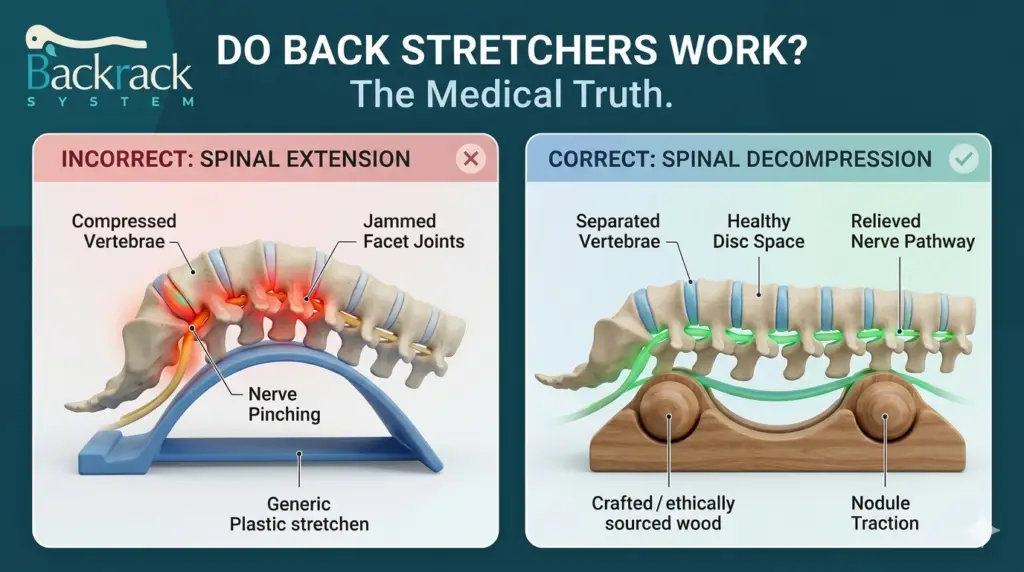
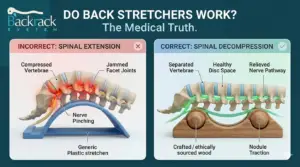
These devices force your body into a movement called spinal extension.
When you bend your spine backward over a hard plastic arch, you are not pulling the bones apart. Instead, you are jamming the facet joints at the rear of your spine closer together.
If you are currently comparing different options on the market, we highly recommend reading our complete clinical breakdown to help you find the best spinal decompression device for your specific type of back pain.
Why Spinal Extension Causes Muscle Spasms
Your body is incredibly smart. When you forcefully jam your facet joints together using a plastic stretcher, your nervous system perceives this as a threat.
To protect your spine from damage, your back muscles will automatically tighten and lock up. This is called a protective muscle spasm.
Instead of relieving your pain, these cheap devices often leave you feeling more stiff, sore, and inflamed the next morning. They treat the spine as a single block of wood, completely ignoring the complex, individual joints.
The Medical Solution: True Spinal Decompression
To achieve lasting results, you must move away from spinal extension and focus entirely on spinal decompression.
Decompression is a foundational principle of orthopedic medicine. It involves gently and progressively pulling the spine lengthwise.
By creating negative pressure within the spinal column, you achieve three critical healing phases:
- You separate the vertebrae, stopping the facet joints from grinding together.
- You create a vacuum effect that allows bulging discs to retract and absorb healing fluids.
- You open the nerve pathways, immediately relieving the pressure that causes sciatica and shooting leg pain.
True decompression does not happen instantly. It requires a progressive, targeted approach using a device that respects your natural anatomy.
The Spinal Backrack™: A Class I Medical Device
If you want to decompress your spine safely and effectively at home, you need clinical-grade hardware.
The Spinal Backrack™ was engineered based on over 45 years of clinical spinal expertise. It is not a plastic fitness gadget; it is a Class I, CE-marked medical device designed by world-renowned specialists.
The Backrack reverses the root cause of your pain using your own body weight and highly precise orthopedic engineering.
The Suspended Spinal Canal
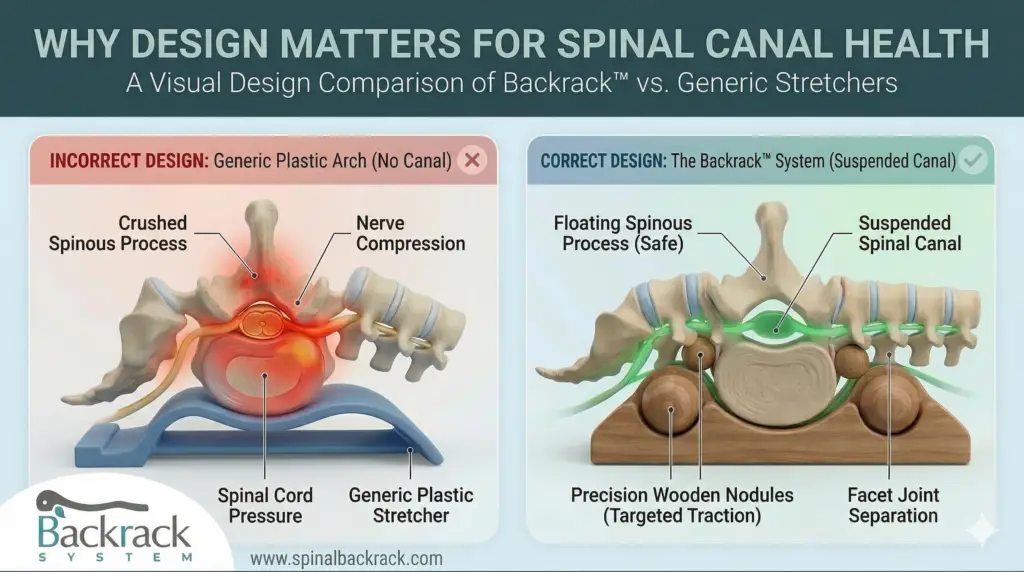
The most dangerous part of a flat plastic stretcher is that it presses directly against your spinal cord and prominent bones.
The Backrack features a deep, suspended central canal. When you lie flat on the device, your actual spine floats safely in this channel, entirely protected from direct pressure or bruising.
Precision Wooden Nodules
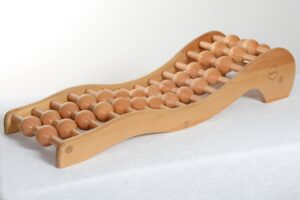
Instead of a smooth, generic arch, the Backrack is constructed from ethically-sourced wood and features perfectly spaced, dual-nodule rows.
Why wood? Because true orthopedic joint manipulation requires firmness. Foam rollers and plastic arches compress under your body weight. Because they are crafted from solid wood, the nodules maintain strict structural integrity without softening.
These nodules act exactly like the thumbs of an orthopedic specialist. They fit precisely into the soft tissue between each individual vertebra. As you lie on the rack, the nodules gently push the bones upward and outward, physically decompressing the spine.
Full-Spine Rehabilitation
A cheap lumbar stretcher only targets the lower back. However, spinal compression is rarely isolated. If your lower back is compressed, your neck and middle back are likely suffering as well.
The Backrack treats the entire spine simultaneously. From the cervical (neck) region, through the thoracic (middle back), down to the lumbar (lower back), it provides comprehensive, full-body decompression.
While the Backrack is your primary tool for clinical-grade treatment at home, wearing a lumbar decompression belt during the day can provide active support and maintain proper joint spacing while you are sitting at your desk or driving.
How the Backrack Treats Specific Pathologies
Because the Backrack targets the structural root cause of pain, it is highly effective for a variety of severe conditions.
Sciatica Relief
Sciatica is characterized by sharp, shooting pain traveling down the leg. It occurs when a compressed lumbar spine traps the sciatic nerve. The Backrack gently lifts the L4 and L5 vertebrae, freeing the trapped nerve and allowing the inflammation to subside.
Herniated and Bulging Discs
When a disc herniates, its soft inner core pushes out through the tough exterior. By decompressing the spine on the Backrack, you relieve the pressure squeezing the disc, allowing it the space and time it needs to heal naturally without invasive surgery.
Poor Posture and Text Neck
Hours hunched over a desk or smartphone destroys the natural curvature of your cervical and thoracic spine. The Backrack helps restore this natural alignment, reversing the daily damage of a sedentary lifestyle.
Round-the-Clock Spinal Support
Reversing years of spinal compression requires consistency. Decompressing for 15 minutes a day is excellent, but you must also protect your spine during your daily routine.
This is why the Backrack system goes beyond the floor device. To maintain your newly decompressed spine, we highly recommend integrating the Backrack Lumbar Belt for active support while walking or lifting.
For office workers and commuters, the Backrack Seat Supports ensure that your vertebrae remain protected and properly aligned while driving or sitting at your desk.
Frequently Asked Questions About Back Stretchers
Cheap plastic stretchers that force your spine into a backward bend do not work for long-term relief and can actually worsen joint compression. However, medical-grade spinal decompression devices, like the Backrack, are clinically proven to work by gently separating the vertebrae and treating the root cause of the pain.
With basic plastic models, the pain often forces you to stop after just a few minutes. With the orthopedic Backrack, treatment is a progressive, comfortable process. We recommend performing a specific set of guided movements on the device for 10 to 15 minutes per session.
Yes. You do not need to spend thousands of pounds on clinical decompression machines or weekly chiropractic visits. The Backrack allows you to safely and naturally decompress your spine on your living room floor using your own body weight.
While maintaining healthy levels of Vitamin D, Calcium, and Magnesium is vital for overall bone density, supplements cannot fix a mechanical issue. If your spine is physically compressed, no amount of vitamins will separate the bones. You need mechanical decompression to achieve true relief.

Take Control of Your Spinal Health Today
You do not have to accept chronic back pain as a permanent part of your life. You also do not need to rely on temporary fixes, endless cycles of painkillers, or risky surgical procedures.
By investing in true spinal decompression, you are investing in a lasting solution.
When you purchase the Backrack, we do not leave you to figure it out alone. Every device comes with a comprehensive manual featuring over 50 targeted exercises.
More importantly, every purchase includes a free 30-minute 1:1 online session with our back care specialists. We will walk you through exactly how to use the device for your specific pathology, ensuring you get the absolute best results.
Stop managing your symptoms and start treating the cause.
Discover the Backrack™ Spinal Decompression Device Today
-

Backrack™ – Spinal Decompression Device
£300.00 Select options This product has multiple variants. The options may be chosen on the product page -

Backrack and Backrack Lumbar Belt Combo Offer
£350.00 Select options This product has multiple variants. The options may be chosen on the product page
More from our blog: